Blog English
Labor Migration
Never before had I four Uzbeks in my swimming pool.Muscular men, somewhere between their mid-thirties and early forties, without the slightest hint of a belly. They are construction workers, here to repair my leaking pool.
The first thing they do upon entering the gate is swap their neat shoes for work shoes—plastic slippers, in this case. Their spotless white sneakers—how do they keep them so pristine along these dusty streets?—are placed carefully under my kitchen table. The foreman, the most handsome of the group, knocks politely before stepping inside. You don’t just enter someone’s home unannounced.
The Work Begins
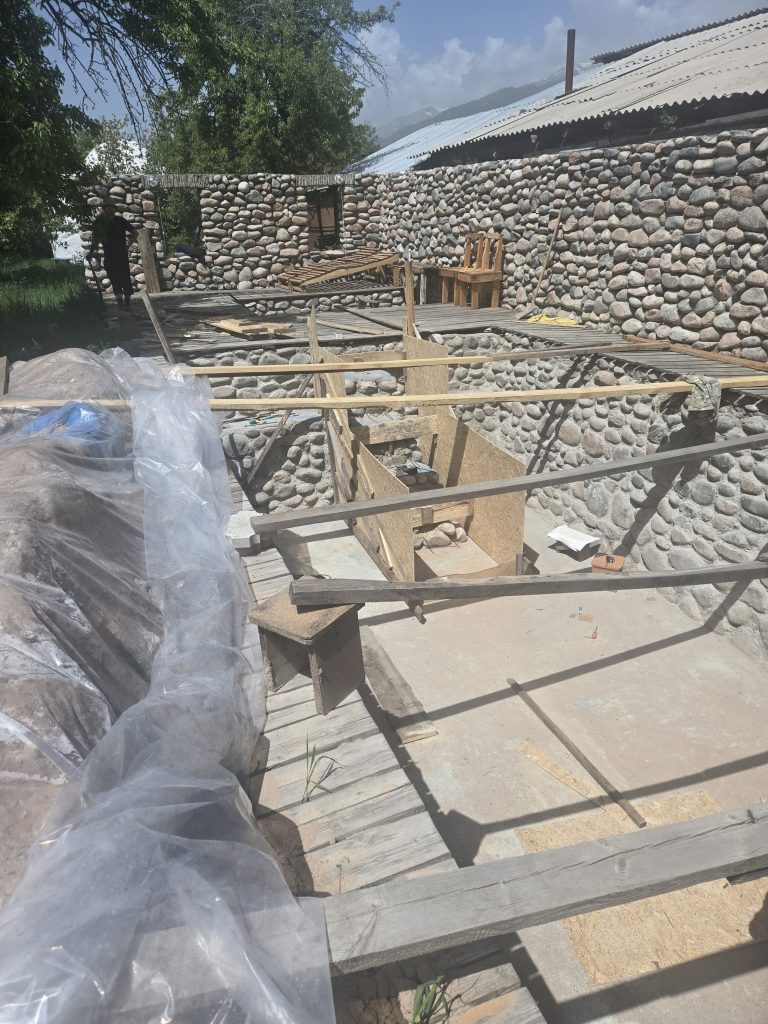
The task is brutal: removing the silicone sealant I once naively applied to the river-stone walls of the pool. With knives and steel brushes they attack the job, without complaint. White cloths tied around their heads shield them from the burning sun, making the foreman look even more striking. One of them is cheekier—he doesn’t greet me, and during breaks he sprawls in my hammock.
Yet I am grateful. The Uzbeks work hard and tidy. Tools are returned to their place at the end of the day. My local handyman could learn from them; just recently I found a butterfly knife left in the toilet and a crowbar on the kitchen table. Not so with these men. Once the walls are clean—surprisingly quickly—they build a concrete staircase, piling the sand for cement neatly to the side.
Language and Connection
Luckily, I understand and speak a little Uzbek. It lightens the atmosphere and, I imagine, earns their sympathy. They work with extra care, I think. Still, construction often requires no words—only gestures. Inevitably, it turns into a game of charades: one hand clenched in a fist, the other twisting to mime a screwdriver. Even that fosters closeness.
I borrowed the Uzbeks for a few days from my neighbors, who had no work for them at the time. And really, you don’t let a team of hardworking men in the prime of their laboring lives sit idle.
Migrant Labor in Kyrgyzstan
Here, Indians, Pakistanis, and Uzbeks do the “dirty” work. Indians and Pakistanis mostly in road construction, contracted by Chinese firms. Rumor has it Pakistanis are paid only back home through a state agency, and if they fall ill, they are sent back immediately. Uzbeks focus on house construction—and now, apparently, pool repair.
In my village, young Kyrgyz men are scarce. Thousands leave for Russia to take low-paid jobs. At home, migrants fill the gaps Kyrgyz themselves can no longer cover. The result is a circulation of money and trade, but little sustainable production or growth of a local economy. A system where everyone moves, but no one truly advances.
Reflection
Of course, it’s amusing to boast about having four Uzbeks in your pool. But beneath the humor lies pain: Kyrgyzstan remains dependent on remittances and temporary labor instead of structural development and self-sustaining growth. I would prefer local workers—even if I had to chase them to stop leaving butterfly knives and crowbars lying around.